Several people have asked me what information I have about the origin of foosball. It immediately occurred to me that I should split this question in two. for, and the sport the origin of the question. Let's start with the former, as this could be relatively easily settled with a "I don't know", since no dictionary of the term has it. This leaves two possibilities: originally or could have been an imitation word, which is the getaway solution and can be blamed on pretty much anything, or a slang expression that has become distorted could be about. I read an argument about it in a forum on the index, which I find acceptable, but of course it is also quite far from the truth.
Origin of the word foosball
In a heated state, for example during a very intense game of foosball, players will often cry out in joy or frustration. From this is the, or the English "yes" is quite common after goals, but in German, stable players who score consecutive goals are often referred to as "machine", while competitors from French-speaking countries often say "oui monsieur", or "p**ain" swearing.
In other words, in a heated state, as a projection of success, we often use all sorts of words, and link to slang has basically two meanings according to the Hungarian Slang Dictionary. One is the wonder/miracle report. The other is goodbye - this is a distorted version of ciao/csao - often used to taunt your opponent, ending the match and sending him away from the table. The above is not something I've just plucked out of my little finger, but from the e-language which I found on this page index forum for reference and this explanation, for want of a better one, may be correct.
The origins of foosball as a sport
About the sport - what it is at home officially only leisure activities - there are several theories. The different stories can be split in three directions, but completely accurate sources are not available. In the early 1900s, the sport was not followed nearly as closely as it is today, so any one or all of these could be true. It's also not entirely clear what we call foosball or what exactly fits into the sport, which you'll find out when I explain the various origins in more detail.
But before we do, let's take a short detour, because organised, high-court football was invented sometime in the 1860s. It is certain that foosball was invented later than that, sometime in the 1890s. In fact, of course, everyone wanted to translate football into a form that could be played indoors in the home, and so board games with a football theme were created. The Americans claim that the first patent relating to a foosball table was registered in the USA, sometime around 1901, but I have not found any credible source that can confirm this. It is generally believed to be more associated with Western Europe, so here are the origin stories. Let's start from the south, from Spain!
The origin of foosball: the Spanish line
One possible trend is the Spanish line, which Alexandre - originally Alexandre Campos Ramírez - de Finesterre who was a telegraph operator, a profession that still existed in the 1930s. He was the founder of the Patent dated 1937, which was registered in Spain, but during the turbulent years of the Spanish Civil War, the documents proving this were lost. There are several theories as to how this happened, some claiming that the documents were lost and destroyed on a boat trip. Later, Alejandro got together Francisco Javier Altuna to put the patented table into production, but this was thwarted by various dubious elements, including allegedly the mafia, in the hope of profiteering.
Alexandre in his patent even fútbolin refers to the sportsbook as. In Spanish, this is still the name of the game, apart from a few South American countries where the metegol and its variants are used. This is because Alexandre left Spain in 1937 and only returned to the country with the fall of the Franco dictatorship in 1976. In the meantime, he travelled around Latin America, promoting and perfecting his invention.
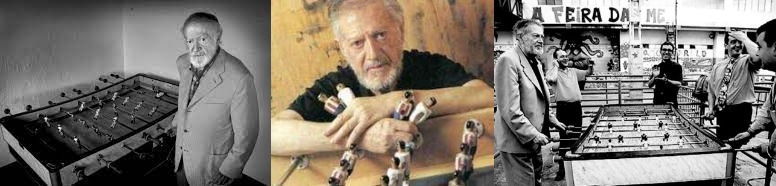
Alexandre De Finisterre
It is important to note that in the picture below, Alejandro is standing next to a two-legged foosball table with fork legs and a "boat" body. This style of play has been official since 2023 recognised by the international federation ITSF. Nevertheless, it is a far cry from the way you might be used to playing in Hungary - or indeed in most of Europe. Here, you can catch and kick the ball with a forked foot, and to the outside observer the game looks more like a game of swipes than a game of organisation.
The origin of foosball: the English line
Another possible scenario is the creation of a foosball table Edwin Lawrence who was responsible for 1913-created the sport in , Despite this Harold Searles Thornton is the first person to be associated with such a patent, or at least the first Englishman to file 1923 to the English Patent Office with his patent application. We even know the trademark number: 205,991. A picture of the construction of the table was also produced, which shows that there are many similarities between modern and contemporary tables. Fun fact: Harold made the first foosball table because he was a fan of Tottenham Hotspurs and wanted to somehow bring football as a game indoors. The idea came from the matches in the matchbox and the box that surrounds it, so the first foosball table was made in exactly that size.
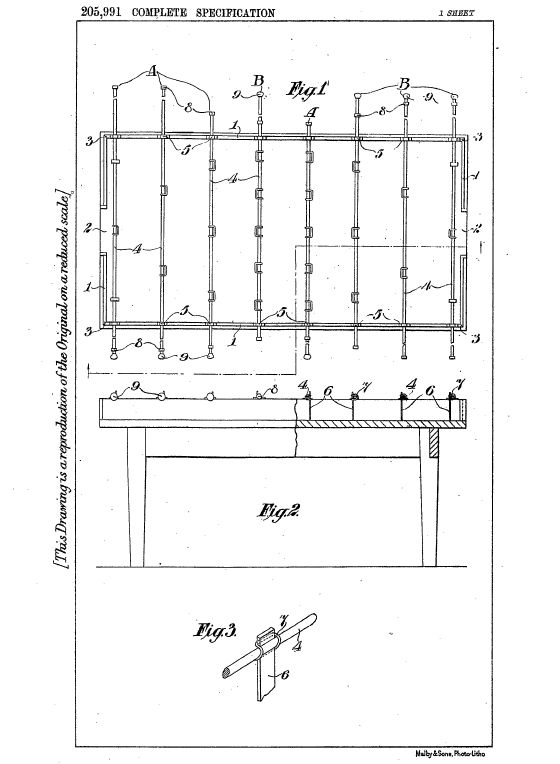
Table copyrighted by Harold Searles Thornton
Another oddity is that, since the English word soccer refers to football, the desktop version of this is logically table-soccer and the sport is still referred to as such today. Despite this, in the USA the foosball a term that has nothing to do with the local word football, which is roughly the equivalent of rugby. Its origins date back to sometime after the Second World War, when American soldiers were transporting foosball tables from Germany to the new homeland. The Germans football and from the words of the foosball which became even more widespread in the 1950s thanks to the Lawrence Patterson - who was a soldier stationed in West Germany - German Champion tables imported into the US from Germany.
The irony is that in the UK, the US Tornado tables are now used at a competitive level - along with the Italian table manufacturer Garlando - so we've basically come full circle and we're back from America to England.
Origin of the foosball: French line
The French line to none other than To Lucien Rosengart who was both an automotive engineer and a businessman. In fact, cars were produced under the name Rosengart from 1927 until 1951. Despite this Lucien Rosengart's name is best associated with Peugeot and Citroen. But what's the connection to foosball? He supposedly designed the table for his family, or more specifically his grandchildren, so that they could keep themselves occupied when they were bored. This was once the 1930s could have happened, as reported in the Belgian magazine Le Soir illustré in 1979, on page 26 of issue 2471.
To support this origin, it is argued that Lucien was a great inventor, and that his name is associated with, for example, the early seat belt or artillery shell developed during the warthat exploded in the air. So, if he is credited with such modern inventions, why not be one of the inventors of the foosball table?

one of the inventors of foosball, Lucien Rosengart
It is a French peculiarity that the nation does not use the words table-soccer or foosball for foosball, but babyfootwhich is also said to be by Lucien Rosengart. Also interestingly, there are still foosball tables sold under the name Rosengart, but it is not French, but Slovakian, and it is used mainly for competitions in Slovakia and the Czech Republic.
The other line of thought is that of Paul Bonzini, who founded the Bonzini company near Paris in 1927, which is still in operation today. He made furniture and kitchen cabinets, and then turned to the entertainment industry In 1936, the first Bonzini foosball table was produced. Today Bonzini is one of the world's leading manufacturers of foosball tables. It is still the official table of the French Foosball Federation.
What happened overseas, in the USA?
The topic of the origins of foosball would not be complete without the history of American foosball. In connection with the English line, I have already mentioned the American line, which is actually a compilation of elements of history, mainly related to European countries. First of all, let us go back a little to Searles Thornton, or rather his uncle, Louis P. Thornton, who took Harold's idea to the United States. He obtained local patents in 1927, but foosball had not yet become popular in America. On the other hand, this version of the table differs only slightly from the modern tables that are common today.
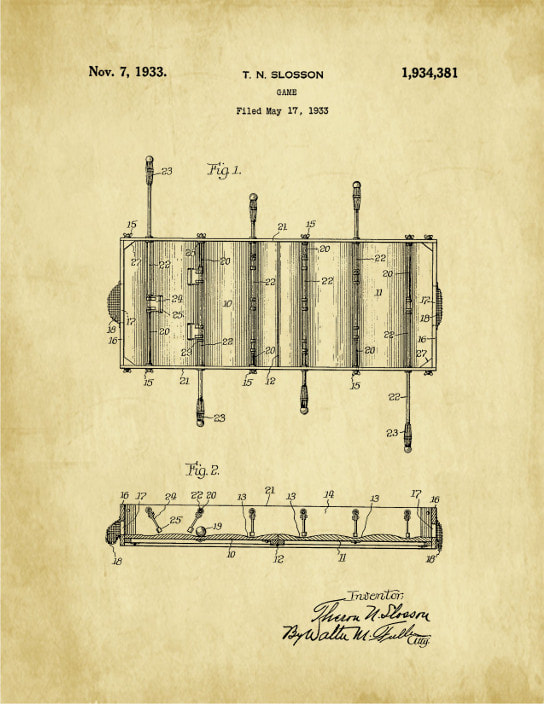
The Theron N. Slosson patent
In 1933, the Chicago Theron N. Slosson registered the first US foosball table patent, Under the name Slosson table, which we know from the fact that the patent drawings are still available today. The next table was built in 1941, and then in 1969. These are all European standards, with specific modifications, and the already mentioned Lawrence Patterson who German champion chains imported into the US. The sport was eventually In 1962, it became established, and from there the sport began to spread in the United States, reaching its peak in the late 1970s.
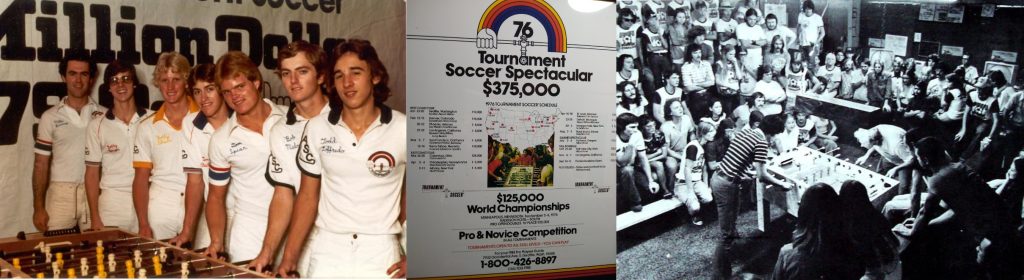
Left: top players (right: Todd Loffredo, who is still active today); middle: 1976 edition; right: a final from the 1970s.
In the 70s and 80s, America was burning in a fever of soup. In case you can't imagine what it looked like back then, here are some facts about the races back then:
- with a minimum total prize money of USD 20 000 organised competitions, followed by crowds of tens of thousands
- in addition to the cash prize, an occasional Porsche-or a Corvette-were also drawn in a competition
- one of the biggest - 250 thousand dollars total prize money - a series of competitions 32 cities organized by a Montana bar owner and avid foosball player, E. Lee Peppard, who also produced his own table, Tournament Soccer Table at
- perhaps the highlight of the foosball game at the time was 1978 International Tournament Soccer Championship (ITSC), which was total prize money reached $1 million
- last but not least, a movie about foosball was made, called "Longshot", a feature-length film debuted in 1981 and was shot in Los Angeles. Since then, several films have been made about the sport, including 2019's Foosballers, which features current stars
The first unadulterated, all-American foosball table, the Tornado, designed in 1971 by Bob Hayes and Bob Furr and had it manufactured. This model, and a modified version of it, the T3000, is still in use today by the American Foosball Association.
The origin of foosball: Hungary
I asked my family members what they remembered from their time, how widespread foosball was in our country. My grandfather was a soldier, and he mentioned that the army had tables even before the change of regime, so that soldiers stationed in barracks who were not doing their duty would have something to pass the time. This was confirmed by my father's peers, who said that there were tables in their time too. Somehow, none of the conversations suggested that the activity was hugely popular, and no one had ever heard of a home-made table ever having become widespread - apart from the short-lived Sardi racing table in the mid-2000s.
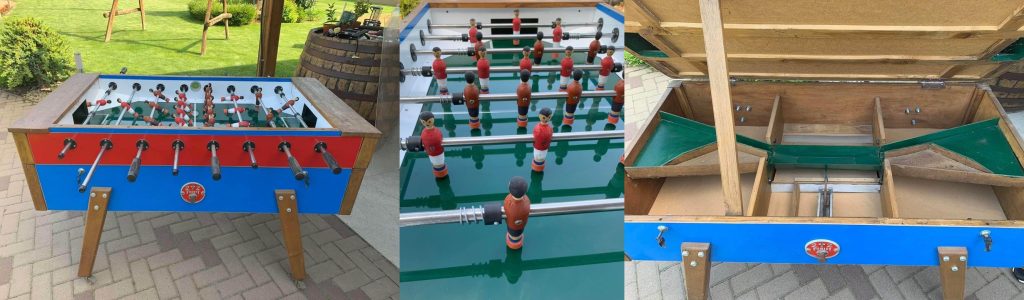
Probably a Czech table from the 80s
The situation changed after the regime change. At first, perhaps Czech made, from the 70's and 80's, originally operating with 2 Ft - then quickly increased by the pub owners - you could see tables with chips and round-legged dummies, where the game was still very different from today. Then in the 90s, especially in the second half of the 90s, the country was devastated by Italian tables, models from Sardi, Fas and Garlando. In particular, the latter manufacturer Olympic - in Hungarian Olimpia, at least that's what everyone colloquially calls it - and the newer Olympic Silver variants have spread. They are still used in nightclubs today. Garlando also became the racing table of Hungary, in the early 2000s on Garlando Maracanaki, and from 2005 onwards on Garlando WMs, until roughly 2012.
There was another detour for Hungarian foosball in the Sardi table manufacturer, sometime between 2006 and 2009. The story goes that Novoparts Ltd, the distributor of the tables in Hungary, approached the then federation to support the sport with money and table development. A new competition table based on Garlando became the result of the umpteenth iteration of the development, a couple of which I saw live at the time: this Sardi Sport. A couple of national competitions have been held there under the name Novoparts Open, but the initiative has not been very successful. Unfortunately.has not lived up to expectations, to put it mildly, the quality was poor, the players didn't like it, and there wasn't really that much difference between Garlando and Sardi's tables, so it wasn't really a big improvement.
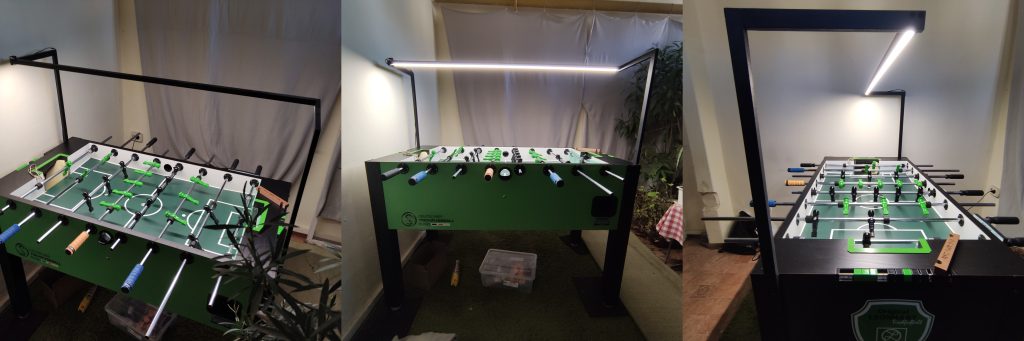
Official tournament table in Hungary: the Leonhart Pro Tournament
Around 2012, our nation changed tables and "systematised" the German Leonhart Pro Tournamentet, which allows for higher quality and more accurate play. The pubs continue to be dominated by Garlando Olympics - or the FAS and Sardi models in the less competent public - but you can occasionally run into Leonharts, and Budapest's Kiskörút was once full of Roberto Sportok, also from an Italian manufacturer. And in the surrounding countries there is the Rosengart - Slovakia, Czech Republic - which is worth a look if you're in a place where it's available. Tornado - American -, Bonzini - French - or even Jupiter - Belgian - table is rare in our country, but in private hands - typically racing - there are 1-1 pieces, as in private hands in our country Fireball and more Ullrich-Sport - a foosball table linked to the German P4P organisation. All these tables will be described in more detail in the on csocso.eu blog, you should check back there from time to time.
Sources
Cocosse: https://www.cocosse.com/2015/02/alphabetarion-foosball-table-football/
Foosballzone: https://www.foosballzone.com/who-invented-foosballtable-football/
Smithsonianmag: https://www.smithsonianmag.com/history/the-murky-history-of-foosball-314668/
Tradgames: https://www.tradgames.org.uk/games/table-football.htm
Bhpltdohio: https://www.bhpltdohio.com/store/p49/1934381-Foosball_Game.html